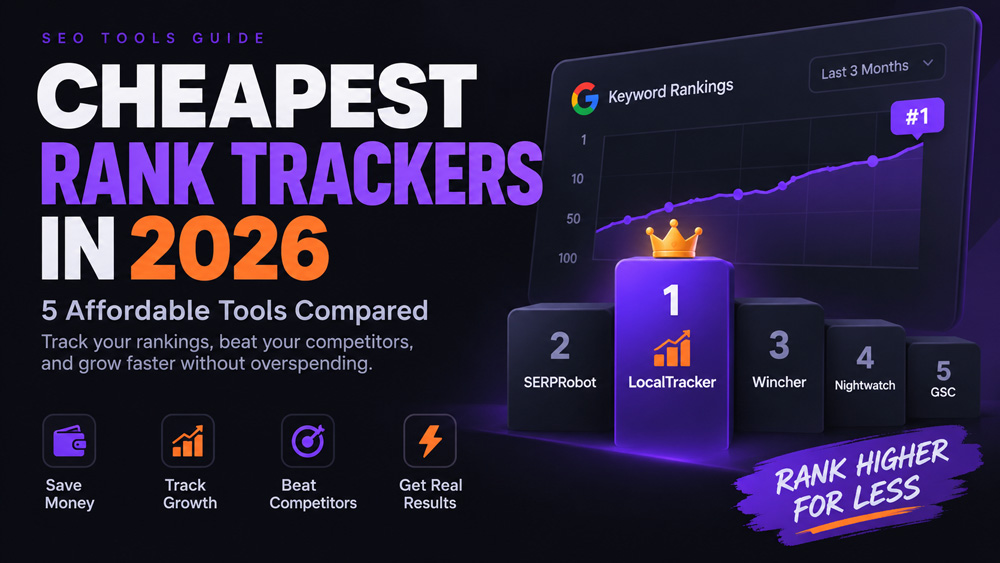
A business may only want to know where its website ranks for 50, 100, or 500 important keywords, yet many SEO platforms bundle rank tracking with audits, backlink databases, content tools, AI features, and dozens of other functions. Those additions can be useful, but they can also turn a simple rank-tracking requirement into another sizeable monthly subscription.
If your main question is simply, “Where does my website rank for the keywords that matter to my business?”, you don't necessarily need a huge SEO suite.
There are dedicated rank trackers that focus much more heavily on keyword positions and can cost considerably less.
In this guide, we'll look at five rank-tracking options worth considering in 2026, starting with an especially inexpensive option for users who mainly need straightforward daily tracking.
Quick Comparison: Cheapest Rank Trackers in 2026
| Rank Tracker | Starting Point | Best For |
|---|---|---|
| LocalTracker | $1/month per 50 daily checks | Low-cost daily rank tracking |
| SERPRobot | $4.99/month per 75 daily updates | Budget users wanting established SERP tracking |
| Wincher | Varies by plan | Businesses wanting tracking + SEO tools |
| Nightwatch | €79/month on current yearly Starter pricing | Agencies and advanced local SEO |
| Google Search Console | Free | Basic first-party Google search performance data |
Pricing and product features can change, so always check the provider's current pricing before subscribing.
What Is a Rank Tracker?
A rank tracker is an SEO tool that monitors the position of a website in search results for specific keywords.
Imagine that you run a plumbing company in Chicago.
You might want to monitor keywords such as:
- plumber Chicago
- emergency plumber Chicago
- water heater repair Chicago
- drain cleaning Chicago
- plumbing company near me
You could manually search Google every morning and try to find your website, but that quickly becomes impractical.
Searching 100 keywords manually could take hours. The results may also be affected by your location, browser history, device, language, and personalization.
A rank tracker automates the process.
You normally create a project, enter your website, choose a search engine and location, and add the keywords you want to monitor. The service then checks search results periodically and records where your domain appears.
Over time, you build a ranking history.
Instead of simply knowing that you're currently position 14, you can see that the page moved from position 31 to 22, then to 17, and eventually to 14.
That historical information is where rank tracking becomes especially useful.
Why Do You Need a Rank Tracker?
Google Search Console already provides search-performance information, so it's reasonable to ask why anyone needs another tool.
The difference is primarily monitoring versus reporting.
A dedicated rank tracker lets you define the exact search terms you care about and continuously monitor their positions. Depending on the platform, you may also be able to specify location, search engine, device, competitors, or other parameters.
This makes rank tracking useful for several situations.
Measuring SEO work
Suppose you optimize a page targeting “best accounting software for freelancers.”
You don't necessarily expect an immediate jump to position one. SEO movement frequently happens gradually.
Your page might move:
83 → 51 → 29 → 17 → 11 → 7
Without historical tracking, it is easy to miss that progress.
Detecting ranking losses
Tracking also works in the opposite direction.
If an important keyword suddenly falls from position 4 to position 22, you want to know about it.
That change could be related to a competitor improving its page, a technical problem, an algorithm change, search-intent changes, or another SEO issue.
Tracking competitors
Competitor rankings provide context.
Being position 12 doesn't tell the entire story if your three biggest competitors occupy positions 2, 3, and 5.
Monitoring competing domains can help identify where you're gaining ground and where additional work is required.
Reporting SEO results
For agencies, rank tracking is also one of the easiest ways to communicate progress.
A client may not care about crawl depth, canonicalization, or hundreds of technical metrics. They understand:
“You were position 18 three months ago. You're position 5 today.”
That is concrete.
1. LocalTracker — Cheapest Option for Straightforward Daily Tracking
For users primarily interested in keeping rank-tracking costs low, LocalTracker takes a deliberately different approach from large all-in-one SEO platforms.
Rather than requiring users to purchase an expensive package containing dozens of tools, LocalTracker is built around affordable ranking capacity.
The current pricing model starts at:
$1 per month for 50 daily keyword checks.
That means someone with a small website doesn't have to purchase hundreds or thousands of keyword slots they aren't going to use.
For example:
- 50 daily checks — $1/month
- 100 daily checks — $2/month
- 250 daily checks — $5/month
- 500 daily checks — $10/month
This model is particularly attractive to freelancers, small businesses, niche-site owners, affiliate marketers, independent SEOs, and agencies managing smaller projects.
LocalTracker supports project-based rank monitoring and lets users select their target search environment. It also supports competitor monitoring so you can compare your own visibility against other domains appearing in the same search results.
One useful aspect of competitor tracking is that the system can identify competitors from the same SERP data retrieved for the primary keyword check. In other words, competitor comparisons do not necessarily require treating every competing domain as an entirely separate keyword search.
LocalTracker also provides ranking history, making it possible to see whether individual keywords are moving upward or downward instead of looking only at today's position.
There's also a Free SERP Checker for people who want to perform occasional checks without immediately creating a full tracking project.
Who should use LocalTracker?
LocalTracker makes the most sense if your priorities are:
low price, simple daily tracking, competitor comparisons, location-based tracking, and straightforward reporting.
It's intentionally more focused than giant SEO platforms.
If you need an enormous backlink database, content-writing platform, enterprise site crawler, or an entire digital-marketing suite, you'll probably still need additional software.
But if rank tracking itself is what you need, paying for a massive SEO suite can be unnecessary.
Best for: Small businesses, freelancers, SEOs, niche websites and budget-conscious agencies.
Starting price: $1/month per 50 daily checks.
Free option: Free trial plus a Free SERP Checker.
2. SERPRobot — An Established Budget Rank Tracker
SERPRobot is another interesting option if affordability is high on your list.
Its pricing model is also based around “bots.”
At the time of writing, one paid SERP Bot costs $4.99 per month and provides 75 keyword updates every 24 hours. The company also offers a 14-day trial.
This makes the pricing fairly easy to understand.
If you have 75 keywords that need daily updates, one bot is sufficient. Around 150 daily keywords would require two bots, and so on.
That simplicity is one reason SERPRobot has remained interesting to people who don't want a complicated enterprise SEO subscription.
SERPRobot is particularly appropriate for someone who already knows which keywords need monitoring and primarily wants consistent position data.
Its pricing is higher per daily keyword capacity than LocalTracker's current pricing, but it's still inexpensive compared with many larger SEO platforms.
The 14-day trial is useful too, since you can test the workflow before paying. SERPRobot says its trial doesn't require a credit card and includes a trial bot capable of updating 10 keywords every 24 hours.
Best for: Freelancers, small businesses and SEO professionals looking for an established low-cost tracker.
Price: $4.99/month per bot, with 75 keyword updates per 24 hours.
Trial: 14 days.
3. Wincher — More Than Basic Position Tracking
Wincher moves further toward being a broader SEO platform.
Its rank tracker provides daily ranking updates, geographic tracking, device tracking, keyword grouping, SERP features, exports, competitor monitoring and other SEO functionality.
That additional functionality changes the type of customer it suits.
If you're tracking rankings simply because you want to know whether 100 keywords moved up or down, a simpler tracker may provide better value.
But once your workflow involves multiple websites, teams, reporting, keyword research and integrations, additional features become much more important.
Wincher's current plans begin with capacity for 500 keywords and up to 10 websites, while higher tiers increase keyword allowances and provide additional team and reporting capabilities.
Competitor tracking is included as well, with the number of competitors per website increasing on higher plans.
That makes Wincher particularly interesting for companies that have outgrown very basic tracking but don't necessarily want an enormous enterprise SEO suite.
Best for: Small and medium businesses that want rank tracking combined with additional SEO research and reporting functionality.
Not ideal for: Someone whose overriding objective is obtaining the absolute lowest cost per tracked keyword.
4. Nightwatch — Powerful Tracking for Agencies and Local SEO
Nightwatch is significantly more sophisticated, but it also sits in a different price category.
Its current Starter plan lists 500 daily tracked keywords for €79/month when billed yearly, while Professional provides 2,500 and Agency provides 7,500. Nightwatch also advertises a 14-day trial without requiring a credit card.
So why include it in an article about affordable rank trackers?
Because price alone doesn't determine value.
An agency may willingly spend more if the platform replaces several smaller tools and reduces reporting work.
Nightwatch provides tracking across multiple search engines and offers particularly detailed geographic tracking. Its current product information advertises coverage across more than 107,000 locations, alongside daily updates and competitor monitoring.
It has also expanded beyond traditional blue-link rank tracking into AI-search visibility and related SEO tooling.
For an individual running one small website, that could be overkill.
For an agency tracking clients in dozens of cities, however, those capabilities can be valuable enough to justify the higher monthly bill.
This illustrates an important point when comparing rank trackers:
The cheapest subscription isn't necessarily the cheapest solution for every business.
If a $10 tool requires hours of manual work that a $79 tool automates, the more expensive product could actually cost the business less overall.
Best for: Agencies, local SEO professionals and teams requiring sophisticated location tracking and reporting.
Starting plan: €79/month equivalent when Starter is billed yearly, based on current published pricing.
Trial: 14 days, no credit card required.
5. Google Search Console — Free, but Not a Traditional Rank Tracker
There's one option that technically beats every paid tool on price:
Google Search Console.
It's free.
Search Console shows queries that generated impressions and clicks for your website, along with average position, impressions, clicks, and click-through rate.
That's extremely valuable information, and virtually every website doing SEO should use it.
However, Search Console and a dedicated rank tracker solve somewhat different problems.
A rank tracker begins with the keywords you decide to monitor.
Search Console primarily reports actual Google search performance data associated with your property.
That distinction matters.
Imagine you're launching a new landing page targeting a keyword for which you currently have almost no visibility. You may want to monitor that keyword every day as the page begins ranking.
A dedicated tracker is designed specifically for that workflow.
Search Console is better viewed as an essential companion to rank tracking, not a complete replacement.
For a brand-new business with absolutely no SEO budget, however, it's an obvious starting point.
Best for: Every website owner.
Price: Free.
Main limitation: It isn't designed as a conventional fixed-keyword daily rank-monitoring system.
Which Cheap Rank Tracker Should You Choose?
The answer depends on what you're actually trying to accomplish.
If your main requirement is tracking rankings as cheaply as possible, LocalTracker's current $1-per-50-daily-checks pricing is difficult to ignore.
If you want another inexpensive dedicated tracking service with a longer operating history, SERPRobot is worth considering.
If you need a broader SEO workflow with research, reporting, integrations and more advanced functionality, Wincher becomes more relevant.
If you run an agency, need sophisticated geographic monitoring, or want traditional rankings combined with newer AI visibility functionality, Nightwatch is positioned much further up the feature ladder.
And regardless of which tracker you choose, you should probably connect your website to Google Search Console as well.
The important thing is not to choose software based on the longest feature list.
Choose it based on the work you actually need to perform.
How Many Keywords Should You Track?
This is another place where businesses often overspend.
A small company doesn't necessarily need to monitor 5,000 keywords.
Start with terms that have genuine business value.
For a small local business, 25–100 carefully selected keywords may already provide a useful picture of organic visibility.
A larger website might monitor hundreds or thousands.
You can divide keywords into groups such as:
Money keywords: Search terms directly associated with sales or leads.
Local keywords: Searches containing cities, neighborhoods, or local intent.
Informational keywords: Queries targeted by guides and blog posts.
Brand keywords: Searches containing your company or product name.
Competitor-related opportunities: Search areas where competing businesses consistently outperform you.
Grouping keywords this way makes ranking reports far more useful than dumping thousands of unrelated queries into a tracker.
Don't Obsess Over Position #1
Rank tracking is valuable, but rankings shouldn't become the only SEO metric you watch.
Position #1 is not automatically valuable.
Ranking first for a phrase nobody searches for—or a query that never produces customers—may contribute almost nothing to your business.
Meanwhile, moving from position 14 to position 5 for a commercially valuable keyword can have a much larger impact.
That's why ranking data should ideally be considered alongside:
- organic clicks
- impressions
- conversions
- leads
- revenue
- search volume
- landing-page performance
SEO isn't about creating a dashboard full of green arrows.
It's to increase useful search visibility and ultimately produce business results.
How Often Should Rankings Be Checked?
For most websites, daily tracking is enough.
Search positions naturally fluctuate. Checking a keyword every few minutes usually doesn't produce actionable information and can create unnecessary noise.
Daily measurements provide enough resolution to identify trends while still making historical charts easy to interpret.
Weekly tracking can be sufficient for less important keywords, but important commercial terms are generally more useful when monitored daily.
This is also why pricing based on daily keyword capacity can make sense. You're paying for the amount of meaningful monitoring your project actually requires rather than an arbitrary collection of unrelated SEO features.
Final Thoughts: Cheap Rank Tracking Doesn't Have to Mean Bad Rank Tracking
Rank tracking used to be something businesses frequently purchased as part of an expensive SEO suite.
That is no longer the only option.
Dedicated tools have made it possible to monitor search positions without spending hundreds of dollars every month.
For users who primarily want inexpensive daily monitoring, LocalTracker is our first choice in this comparison, beginning at just $1/month for 50 daily checks.
SERPRobot provides another affordable dedicated option at $4.99 per 75 daily keyword updates. Wincher offers a broader collection of SEO capabilities, while Nightwatch targets more sophisticated tracking requirements, agencies, and local SEO workflows.
Google Search Console should sit alongside whichever option you choose because its first-party search-performance information remains invaluable.
Ultimately, a rank tracker has one fundamental job:
Tell you whether your search visibility is improving or getting worse.
You don't need the most expensive platform to answer that question.
You need a tracker that covers the search engines, locations, keywords, and competitors relevant to your business—and provides that information at a price that makes sense.
For many small businesses and independent SEO professionals in 2026, keeping the tracking layer simple may be the smartest option.